Wednesday, 6 May 2020

Defcon 2015 Coding Skillz 1 Writeup

Just connecting to the service, a 64bit cpu registers dump is received, and so does several binary code as you can see:


The registers represent an initial cpu state, and we have to reply with the registers result of the binary code execution. This must be automated becouse of the 10 seconds server socket timeout.

The exploit is quite simple, we have to set the cpu registers to this values, execute the code and get resulting registers.

In python we created two structures for the initial state and the ending state.

cpuRegs = {'rax':'','rbx':'','rcx':'','rdx':'','rsi':'','rdi':'','r8':'','r9':'','r10':'','r11':'','r12':'','r13':'','r14':'','r15':''}
finalRegs = {'rax':'','rbx':'','rcx':'','rdx':'','rsi':'','rdi':'','r8':'','r9':'','r10':'','r11':'','r12':'','r13':'','r14':'','r15':''}

We inject at the beginning several movs for setting the initial state:

for r in cpuRegs.keys():
    code.append('mov %s, %s' % (r, cpuRegs[r]))

The 64bit compilation of the movs and the binary code, but changing the last ret instruction by a sigtrap "int 3"
We compile with nasm in this way:

os.popen('nasm -f elf64 code.asm')
os.popen('ld -o code code.o ')

And use GDB to execute the code until the sigtrap, and then get the registers

fd = os.popen("gdb code -ex 'r' -ex 'i r' -ex 'quit'",'r')
for l in fd.readlines():
    for x in finalRegs.keys():
           ...

We just parse the registers and send the to the server in the same format, and got the key.


The code:

from libcookie import *
from asm import *
import os
import sys

host = 'catwestern_631d7907670909fc4df2defc13f2057c.quals.shallweplayaga.me'
port = 9999

cpuRegs = {'rax':'','rbx':'','rcx':'','rdx':'','rsi':'','rdi':'','r8':'','r9':'','r10':'','r11':'','r12':'','r13':'','r14':'','r15':''}
finalRegs = {'rax':'','rbx':'','rcx':'','rdx':'','rsi':'','rdi':'','r8':'','r9':'','r10':'','r11':'','r12':'','r13':'','r14':'','r15':''}
fregs = 15

s = Sock(TCP)
s.timeout = 999
s.connect(host,port)

data = s.readUntil('bytes:')


#data = s.read(sz)
#data = s.readAll()

sz = 0

for r in data.split('\n'):
    for rk in cpuRegs.keys():
        if r.startswith(rk):
            cpuRegs[rk] = r.split('=')[1]

    if 'bytes' in r:
        sz = int(r.split(' ')[3])


binary = data[-sz:]
code = []

print '[',binary,']'
print 'given size:',sz,'bin size:',len(binary)        
print cpuRegs


for r in cpuRegs.keys():
    code.append('mov %s, %s' % (r, cpuRegs[r]))


#print code

fd = open('code.asm','w')
fd.write('\n'.join(code)+'\n')
fd.close()
Capstone().dump('x86','64',binary,'code.asm')

print 'Compilando ...'
os.popen('nasm -f elf64 code.asm')
os.popen('ld -o code code.o ')

print 'Ejecutando ...'
fd = os.popen("gdb code -ex 'r' -ex 'i r' -ex 'quit'",'r')
for l in fd.readlines():
    for x in finalRegs.keys():
        if x in l:
            l = l.replace('\t',' ')
            try:
                i = 12
                spl = l.split(' ')
                if spl[i] == '':
                    i+=1
                print 'reg: ',x
                finalRegs[x] = l.split(' ')[i].split('\t')[0]
            except:
                print 'err: '+l
            fregs -= 1
            if fregs == 0:
                #print 'sending regs ...'
                #print finalRegs
                
                buff = []
                for k in finalRegs.keys():
                    buff.append('%s=%s' % (k,finalRegs[k]))


                print '\n'.join(buff)+'\n'

                print s.readAll()
                s.write('\n'.join(buff)+'\n\n\n')
                print 'waiting flag ....'
                print s.readAll()

                print '----- yeah? -----'
                s.close()


fd.close()
s.close()


Read more


  1. Growth Hacking Cursos
  2. Aprender Seguridad Informatica
  3. Blackhat Hacking
  4. Hacking Youtube
  5. Hackers Informaticos Contactar
  6. Aprender A Ser Hacker
  7. Hacking For Dummies
  8. Programas De Hacker
  9. Hacking Python
  10. Hacking Youtube
  11. Libro Hacking Etico
  12. Hacking Wireless 101 Pdf
  13. Curso Growth Hacking
  14. Wifi Hacking App
  15. Hacking Smart Tv
  16. Hacking Hardware

HACKING PASSWORDS USING CREDENTIAL HARVESTER ATTACK

Everything over the internet is secured by the passwords. You need a login to do any stuff on any social or banking website. Passwords are the first security measure for these type of websites. So, I brought a tutorial on how to hack such sort of login passwords. This tutorial is based on credential harvester attack method. In which you will know about hacking passwords using credential harvester attack method.

HACKING PASSWORDS USING CREDENTIAL HARVESTER ATTACK

REQUIREMENTS

It's very simple and easy to follow. Before you start, you need the following things to work with.
  1. Kali Linux OS
  2. Target Website

STEPS TO FOLLOW

  • Run the Kali Linux machine. If you have not Kali Linux installed, you can grab a free copy and install it as a virtual machine. You can learn more about Kali Linux VirtualBox installation.
  • Sign in to Kali Linux by entering username root and password toor.
  • As you'll sign in, navigate to the Applications > Social Engineering Tools > Social Engineering as shown in the following screenshot.
  • Now you will see the different options. You have to choose Social Engineering Attacks by simply entering its number in the terminal. Once you do it, it will show a few options further. Simply choose Website Vector Attack by putting its number.
  • Website vector attack will show up it's a different type of attacks. We are going to use Credential Harvester Attack.
  • Choose the Site Clone option. As you do it, it will ask for your public IP address. Just open up a new terminal and type ifconfig. It'll show the public IP. Just copy it and paste in the previous terminal as shown in the following screenshots.
  • After we do it. Enter the target website of which passwords you want to hack. Make sure to use a website that has username and password on the same page.
  • All done now. As someone opens up the browser on the public IP we specified, it'll show up the website that we entered in the previous step. Now as someone enters their username or password, it will be captured in the terminal.

That's all. If you're not clear yet. You can watch the following complete video tutorial on how to do it.

More articles


  1. Como Empezar En El Hacking
  2. Hacking Smart Tv
  3. Hacking Xbox One
  4. Hacking Raspberry Pi
  5. Cómo Se Escribe Hacker
  6. Hacking Netflix Account
  7. Hacking Growth Pdf
  8. Que Es Growth Hacking
  9. Password Hacking
  10. Que Es Hacker En Informatica

Top System Related Commands In Linux With Descriptive Definitions


Commands are just like an instructions given to a system to do something and display an output for that instruction. So if you don't know how to gave an order to a system to do a task then how it can do while you don't know how to deal with. So commands are really important for Linux users. If you don't have any idea about commands of Linux and definitely you also don't know about the Linux terminal. You cannot explore Linux deeply. Because terminal is the brain of the Linux and you can do everything by using Linux terminal in any Linux distribution. So, if you wanna work over the Linux distro then you should know about the commands as well.
In this blog you will get a content about commands of Linux which are collectively related to the system. That means if you wanna know any kind of information about the system like operating system, kernel release information, reboot history, system host name, ip address of the host, current date and time and many more.

Note:

If you know about the command but you don't have any idea to use it. In this way you just type the command, then space and then type -h or --help or ? to get all the usage information about that particular command like "uname" this command is used for displaying the Linux system information. You don't know how to use it. Just type the command with help parameter like: uname -h or uname --help etc.

uname 

The "uname" is a Linux terminal command responsible of displaying the information about Linux system. This command has different parameter to display a particular part of information like kernel release (uname -r) or all the information displayed by typing only one command (uname -a).

uptime

This command is used to show how long the system has been running and how much load on it at current state of the CPU. This command is very useful when you system slows down or hang etc and you can easily get the info about the load on the CPU with the help of this command.

hostname

The "hostname" is the the command in Linux having different parameters to display the information bout the current host which is running the kernel at that time. If you wanna know about the parameters of hostname command then you just type hostname --help or hostname -h to get all the info about the command and the usage of the command.

last reboot

The "last reboot" is the command in Linux operating system used to display the reboot history. You just have to type this command over the Linux terminal it will display the reboot history of that Linux system.

date

The "date" is the command used in Linux operating system to show the date of the day along with the current time of the day.

cal

The "cal" command in Linux used to display the calendar which has the current date highlighted with a square box along with a current month dates and days just like a real calendar.

w

The "w" is the command used in Linux distro for the sake of getting the information about current user. If you type this command it will display who is online at the time.

whoami

The "whoami" is the command in Linux operating system used to show the information that who you are logged in as. For example if you are logged in as a root then it'll display "root" etc.

finger user

The "finger user" is the command used in Linux distribution to display the information about user which is online currently over that Linux system.

Related word


  1. Hacking Etico Certificacion
  2. Experto En Seguridad Informática
  3. Hacking Mifare
  4. Hacking Web Sql Injection Pdf
  5. Hacking Background
  6. Growth Hacking Tools
  7. Hacking Traduccion
  8. Hacking Madrid
  9. Nivel Basico
  10. Mindset Hacking Nacho
  11. Password Hacking
  12. Hacking News
  13. Hacking Growth Pdf
  14. Linux Hacking Distro
  15. Hacking Con Buscadores
  16. Growth Hacking

Tuesday, 5 May 2020

Probing For XML Encryption Weaknesses In SAML With EsPReSSO

Security Assertion Markup Language (SAML) is an XML-based standard commonly used in Web Single Sign-On (SSO) [1]. In SAML, the confidentiality of transferred authentication statements against intermediaries can be provided using XML Encryption [2]. However, implementing XML Encryption in a secure way can be tricky and several attacks on XML Encryption have been identified in the past [3] [4]. Therefore, when auditing a SAML endpoint, one should always consider testing for vulnerabilities in the XML Encryption implementation.

This blog post introduces our latest addition to the SAML Attacker of our BurpSuite extension EsPReSSO: the Encryption Attack tab. The new tab allows for easy manipulation of the encrypted parts within intercepted SAML responses and can, therefore, be used to quickly assess whether the SAML endpoint is vulnerable against certain XML Encryption attacks.


Weaknesses of XML Encryption

Implementations of XML Encryption can be vulnerable to adaptive chosen ciphertext attacks. This is a class of attacks in which the attacker sends a sequence of manipulated ciphertexts to a decryption oracle as a way to gain information about the plaintext content.
Falsely implemented XML Encryption can be broken using:
  • an attack against the CBC-mode decryption (quite similar to a padding oracle attack) [3] or
  • a Bleichenbacher attack against the RSA-PKCS#1 encryption of the session key  [4].
SAML makes use of XML Encryption and its implementations could, therefore, also be vulnerable to these attacks.

XML Encryption in SAML

To support confidential transmission of sensitive data within the SAML Assertion, assertions can be encrypted using XML Encryption. An EncryptedAssertion is shown in the abridged example below.

<EncryptedAssertion>
  <EncryptedData>
    <EncryptionMethod Algorithm="http://www.w3.org/2001/04/xmlenc#aes128-cbc"/>
    <KeyInfo>
      <EncryptedKey>
        <EncryptionMethod Algorithm="http://www.w3.org/2001/04/xmlenc#rsa-1_5"/>
        <CipherData>
          <CipherValue>
            [...]
          </CipherValue>
        </CipherData>
      </EncryptedKey>
    </KeyInfo>
    <CipherData>
        <CipherValue>
          [...]
        </CipherValue>
    </CipherData>
  </EncryptedData>
</EncryptedAssertion>

The EncryptedAssertion contains an EncryptedData element, which in turn is the parent of the EncryptionMethod, KeyInfo, and CipherData elements.  SAML makes use of what is referred to as a hybrid encryption scheme. This is done using a session key which symmetrically encrypts the payload data (the example uses AES-128 in CBC mode), resulting in the ciphertext contained in the EncryptedAssertion/EncryptedData/CipherData/CipherValue child element. The session key itself is encrypted using an asymmetric encryption scheme. In our example, RSA-PKCS#1.5 encryption is used with the public key of the recipient, allowing the contents of the the EncryptedKey child element to be derived from the KeyInfo element. 

Encryption Attacker

Our BurpSuite extension EsPReSSO can help detect vulnerable implementations with the newly integrated Encryption Attacker within EsPReSSO's SAML module.

Once a SAML response which contains an EncryptedAssertion has been intercepted, open the SAML tab, select the Attacks pane, and choose Encryption from the dropdown menu. This works in Burp's Proxy, as well as in the Repeater tool, and is depicted below.
As sketched out above, the symmetric session key is encrypted using the recipient's public key. Since the key is public, anybody can use it to encrypt a selected symmetric key and submit a valid encryption of arbitrary messages to the recipient. This is incredibly helpful because it allows us to produce ciphertexts that decrypt the chosen plaintexts. To accomplish this, one can purposefully send invalidly padded messages, or messages containing invalid XML, as a method to trigger and analyze the different reactions of the decryption endpoint (i.e, turning the endpoint into a decryption oracle). To facilitate these investigations, the new Encryption Attacker makes this process dead simple.
The screenshot above shows the essential interface of the new encryption tab:
At the top, the certificate used to encrypt the symmetric session key can be pasted into the text field. This field will be pre-filled automatically if the intercepted SAML message includes a certificate in the KeyInfo child element of the EncryptedData element. The Update Certificate checkboxes above the text area can be used to include the certificate in the manipulated SAML message.
In the Symmetric Key text field, the hexadecimal value of the symmetric session key can be set. Choose the asymmetric algorithm from the dropdown menu and click Encrypt key -- this will update the corresponding KeyInfo elements of the intercepted SAML message. 

The payload in the text area labeled XML data can now be entered. Any update in the XML data field will also be reflected in the hexadecimal representation of the payload (found on right of the XML data field). Note that this is automatically padded to the blocklength required by the symmetric algorithm selected below. However, the payload and the padding can be manually adjusted in the hex editor field.

Eventually, click the Encrypt content button to generate the encrypted payload. This will apply the changes to the intercepted SAML message, and the manipulated message using Burp's Forward or Go button can now be forwarded, as usual.

Probing for Bleichenbacher Oracles

Bleichenbacher's attack against RSA-PKCS1 v1.5 encryption abuses the malleability of RSA to draw conclusions about the plaintext by multiplying the ciphertext with adaptively chosen values, and observing differences in the received responses. If the (error-) responses differ for valid and invalid PKCS1 v1.5 ciphertexts, Bleichenbachers' algorithm can be used to decrypt the ciphertext without knowing the private key [6].

To determine whether or not a SAML endpoint is vulnerable to Bleichenbacher's Attack, we simply need to check if we can distinguish those responses received when submitting ciphertexts that are decrypted into invalidly formatted PKCS1 v1.5 plaintexts, from the responses we receive when sending ciphertexts that are decrypted into validly formatted plaintexts. 

Recall that PKCS1 v1.5 mandates a certain format of the encrypted plaintext, namely a concatenation of a BlockType 00 02, a randomized PaddingString (PS) that includes no 00 bytes, a 00 (NULL-byte) as delimiter, and the actual plaintext message. The whole sequence should be equal in size to the modulus of the RSA key used. That is, given the byte length k of the RSA modulus and the message length |m|, PS has the length |PS| = k - 3 - |m|. Furthermore, PKCS1 v1.5 demands that |PS| to be at least eight bytes long [5]. 

In SAML, the recipient's public key is usually known because it is published in the metadata, or even included in the EncryptedAssertion. For this reason, we do not need to fiddle around with manipulated ciphertexts. Instead, we simply submit a validly formatted RSA-PKCS1 v1.5 encrypted message and an encrypted message which deciphers into an invalidly formatted plaintext. As an example, assume an RSA public key of 2048 bits which we want to use to encrypt a 16 byte session key `01 02 03 04 05 06 07 08 09 0A 0B 0C 0D 0E 0F 10` (hexadecimal representation). |PS|$ is $2048/8 - 3 - 16 = 237, so a valid PKCS1 v1.5 plaintext, ready to be encrypted using `AA` for all 237 padding bytes, could look like the listing shown below.

00 02 AA AA AA AA AA AA AA AA AA AA AA AA AA AA
AA AA AA AA AA AA AA AA AA AA AA AA AA AA AA AA
AA AA AA AA AA AA AA AA AA AA AA AA AA AA AA 00
01 02 03 04 05 06 07 08 09 0A 0B 0C 0D 0E 0F 10
In the Encryption attack pane of EsPReSSO, ensure that the correct public key certificate has been added to the Certificate field. Insert a valid plaintext, such as the one above, into the Symmetric Key field and select Plain RSA encryption from the Algorithm drop down menu. Click the Encrypt button to compute the RSA transformation and apply the new EncryptedKey element to the intercepted SAML message. Now, submit the message by clicking Burp's Go or Forward button and carefully inspect the response.

Next, repeat the steps outlined above, but this time submit an invalid PKCS1 v1.5 message. For example, consider using an invalid BlockType of `12 34` instead of `00 02`, or replace the `00` delimiter so that the decryptor is unable to determine the actual message after decrypting the ciphertext. If you are able to determine from the recieved responses whether or not the submitted ciphertext decrypted into a valid PKCS1 v1.5 formatted plaintext, chances are high that the decryptor can be used as a Bleichenbacher oracle. Don't forget to take into account the actual XML data, i.e., the assertion encrypted with the new session key; by submitting valid or invalid XML, or by removing signatures from the SAML message or the assertion you may increase your chances of detecting differences in the returned responses.

Probing for Oracles in CBC-Mode Decryption

Another known attack on XML Encryption is aimed at the Cipher Block Chaining (CBC) mode, which can be used with the block ciphers AES or 3DES [2]. The attack is described in detail in this referenced paper [3] and is quite similar to Padding-Oracle attacks on CBC mode; the malleability of CBC mode encryption enables the attacker to perform a bytewise, adaptive manipulation of the ciphertext blocks which are subsequently sent to the decryptor. In most cases, the manipulated ciphertext will not decrypt to valid XML and an error will be returned. Sometimes, however, the plaintext will be parsed as valid XML, in which cases an error is thrown later on at the application layer. The attacker observes the differences in the responses in order to turn the decryptor into a ciphertext validity oracle which can be used to break the encryption.  Due to some particularities of the XML format, this attack can be very efficient, enabling decryption with about 14 requests per byte, and it is even possible to fully automate the process [7].

In order to determine if a particular SAML service provider is vulnerable to this attack, we can avoid the cumbersome ciphertext manipulation, if we are in possession of the decryptor's public key:
In the Encryption Attacker tab of EsPReSSO, add the public key certificate to the Certificate field (if necessary) and insert a symmetric key of your own devising into the  Symmetric Key text field. Select an appropriate RSA encryption method and click the Encrypt button to apply the new EncryptedKey element to the original SAML message. 

An XML message can now be inserted into the XML data text field. Select a CBC mode encryption algorithm and click Encrypt to apply the changes. As in the example above, press Burp's Go or Forward button to send the message and carefully inspect the response. Try sending invalid XML, e.g., by not closing a tag or using the `&` character without a valid entity and keep an eye open for differences in the returned responses. To manipulate the padding, the text field on the right side shows the hexadecimal representation of the plaintext, including the CBC padding. If you send a single block and set the last byte, which indicates the padding length to the blocksize, i.e. 16 or 0x10 for AES, the ciphertext should decrypt into an empty string and is generally considered "valid" XML.

Please refer to the original paper for more details, tips, and tricks for performing the actual attack [3]. 

Summary

The new XML Encryption attacker included in EsPReSSO can help security auditors to quickly assess if a SAML endpoint is vulnerable to known attacks against XML Encryption. To this end, the decryptor's public key is used in order to send suitable test vectors that can be provided in plaintext. Ciphertext manipulation is, therefore, not required. The actual process of decrypting an intercepted SAML message is, however, considered out of scope and not implemented in EsPReSSO.

In case you wonder how XML Encryption can be used in a secure fashion, here are some considerations [6]:
  • Always use an authenticated encryption mode such as AES-GCM instead of the CBC-mode encryption.
  • Using RSA-PKCS1 v1.5 within XML Encryption is particularly difficult to do in a secure manner, and it is recommended to use RSA with Optimal Asymmetric Encryption Padding (OAEP) instead [2].
  • Apply a digital signature over the whole SAML response, and ensure it is properly validated before attempting to decrypt the assertion. This should thwart the attack as a manipulated response can be recognized as such and should be rejected.
----------
Related word
  1. Blog Hacking
  2. Hacking In Spanish
  3. Paginas Para Hackear
  4. Computer Hacking

UserRecon Tool | Find Usernames | OSINT Tool

Related word
  1. Hacking Iphone
  2. Best Hacking Games
  3. Growth Hacking Cursos
  4. Como Hacer Hacker
  5. Hacking Marketing
  6. Hacking Libro
  7. Tools Hacking
  8. Ingeniería Social El Arte Del Hacking Personal
  9. Hacking Online Games
  10. Kali Linux Hacking
  11. Como Hackear
  12. Hacking Language
  13. Hacking Wifi Android
  14. Curso De Hacking Gratis
  15. Tipos De Hacker

Friday, 1 May 2020

Square Tiling Of A Sphere, Part 1/3

I almost always work on 2D game maps, but occasionally I get intrigued by planetary maps. I'd like to make a planet that uses a grid. The topology of a sphere requires a few things:

  1. Moving east or west you eventually wrap around the world → easy
  2. Moving north/south you eventually reach a pole, and then all directions are south/north → medium
  3. Wrapping around the world east/west is shorter near the poles than near the equator → hard

wraparound.jpg

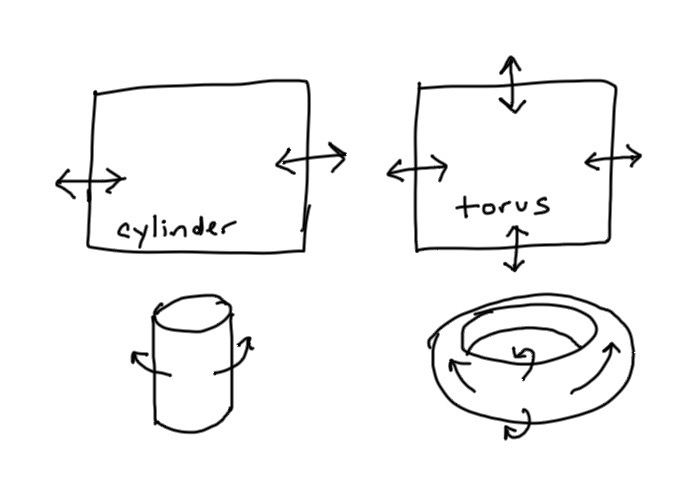
Some grid games like Civilization will let you wrap east/west but not north/south. That acts like a cylinder, not a sphere. And some grid games will let you wrap north/south just like you wrap east/west. That acts like a torus, not a sphere. A tile grid game that acts like a sphere is hard!

A few years ago I played with hexagons covering a sphere. The main idea was that although there are some pentagons scattered around, we can hide them by making the map generator produce impassable terrain (deep oceans, inaccessible mountains, lava, etc.) in those areas, so you can never get close to the pentagons. Also, we have to divide the planet into regions that get shuffled around as you move around. While I was working on that I found some other things I wanted to try, but I didn't try them right away. Why?

I have three kinds of projects:

  1. My "main" projects (hexagonal grids, pathfinding, etc.) are about making high quality explanations. I'll spend a lot of time on these. I usually understand the topic reasonably well.
  2. My "gamejam" projects like this one are about exploring new things. I'll spend a limited amount of time (hour, day, or week) on these. I usually don't understand the topic that well.
  3. My "art" projects are about making something that looks cool.

Since I limit my time on each of the "gamejam" style projects (marked with an /x/ in the URL), once I run out of time, I'll stop, and make a list of things I want to explore later. For the hexagons-on-a-sphere project, I wanted to try squares-on-a-sphere, but didn't have time. I decided to explore that topic last week. I started with HEALPix, a layout used by NASA for placing quadrilaterals on a sphere, but I concluded that it's overkill for my needs. NASA also has the COBE quadrilateralized cube, and there are several other layouts to try. But I'm out of time, so those will be in a future "gamejam" style project. As often happens, I realize towards the end that I should've read more papers first, but sometimes I don't know what to look for until after I've tried implementing something.


Read about covering a sphere in square tiles

Episode 33: Foam Board, Sharp Knives And More Is Live!

Episode 33: Foam board, sharp knives and more!
https://soundcloud.com/user-989538417/episode-33-foam-board-a-sharp-knife-and-more

I talk about building terrain using humble foam board and a few simple tools.

Try Audible for FREE! https://audibletrial.com/tvwg

Housing joint what I incorrectly call tongue in groove in the Ep
http://www.woodworkbasics.com/image-files/170x165xhousing-joint.jpg.pagespeed.ic.9XFvhjVeOA.jpg

Books and games weighing down the walls and floor of a space station module: https://pbs.twimg.com/media/DQ-wTexV4AAPObR.jpg:large

A photo from the archives showing a jig made of Lego bricks to keep everything nice and square and plumb: https://pbs.twimg.com/media/DUmrlbpWsAAwL1C.jpg

Germy's Paper Buildings - Designed with gaming in mind: http://www.germy.co.uk/fprpg.htm

Music courtesy of Bensound.com. Keep your town beautiful, get a haircut.